

Mountains that changed trades
The Erzgebirge, the "Ore Mountains" along the German-Czech border, spent centuries mining silver and tin. As the ore thinned, the region's villages, Seiffen most famously, turned their tool-craft to wood, and by the nineteenth century the area was a center of German toy and Christmas-goods making. The forms it developed, candle pyramids, incense smokers, nutcrackers, angel-and-miner candle holders, are a whole folk cosmology; the ornament drawer holds its smallest citizens, the turned-and-painted figures sized for a branch.
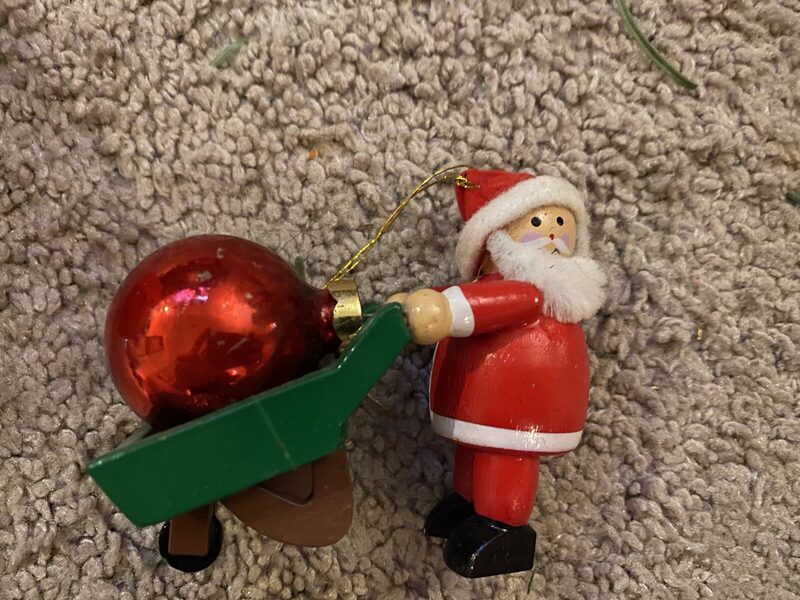
A Santa with a wheelbarrow
A painted-wood Santa from our shelves, wheeling a red glass ball like a prize pumpkin, in the Erzgebirge woodcraft manner. Turned bodies, hand-painted faces, and a little engineering: the workshop drawer in one piece.
How the pieces are made
Classic Erzgebirge work is lathe-turning: bodies, heads, and hats turned as simple solids, then assembled and painted. The region also perfected two showpiece techniques worth knowing by name. Reifendrehen turns a whole ring of wood on a lathe so that its cross-section is an animal; slice the ring and a herd of identical horses falls out. The Spanbaum, the shaved tree, is a single stick curled into feathery boughs with a knife. Both appear in ornament sizes, and both are the kind of thing that makes a collector put down the glass for a while.
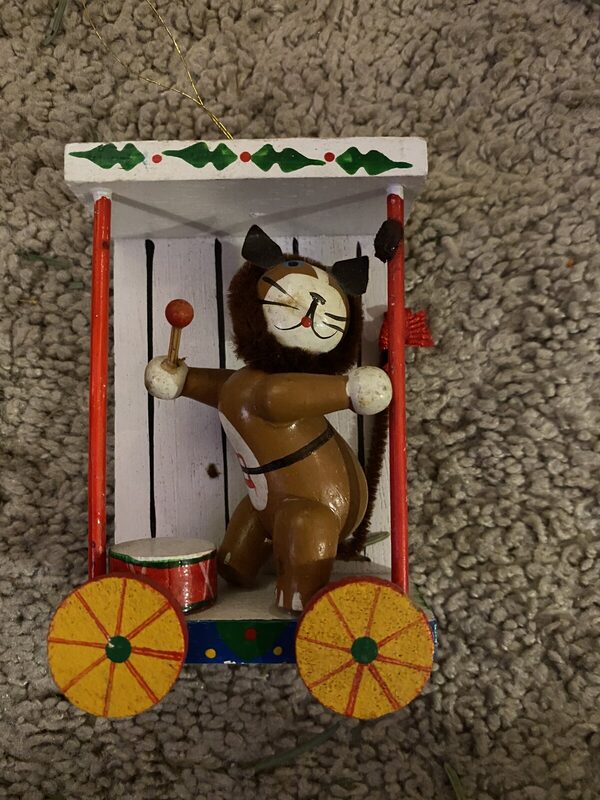
A circus cart in painted wood
A little painted circus wagon from our shelves, its drummer mid-beat, in the German woodcraft manner. The joinery is the joke and the joke still lands.
Reading the wooden drawer
Honest wooden pieces show their making: visible turning marks, paint applied by hand with human variation, and wood that has aged to warmth. The region's established workshops often mark their work, and pieces from named makers carry a premium; unmarked work is judged on craft, not on a story. Beware "Erzgebirge-style" used loosely in listings, as we use it carefully here: the style is imitated worldwide, at every quality. Wood forgives handling better than glass but hates moisture and heat, so the display guide's advice about placement applies with full force.
Beyond the mountains
Not every wooden ornament is German, and the drawer is broad-minded: Russian folk-painted turnery, Scandinavian turned figures, American folk carving, and the flat painted cutouts of family craft nights all live here. What unites them is that wood takes paint, tools, and affection, and keeps all three. For where these pieces are still made and sold, see the Christmas Markets chapter and our Craftsmen & Studios pages.
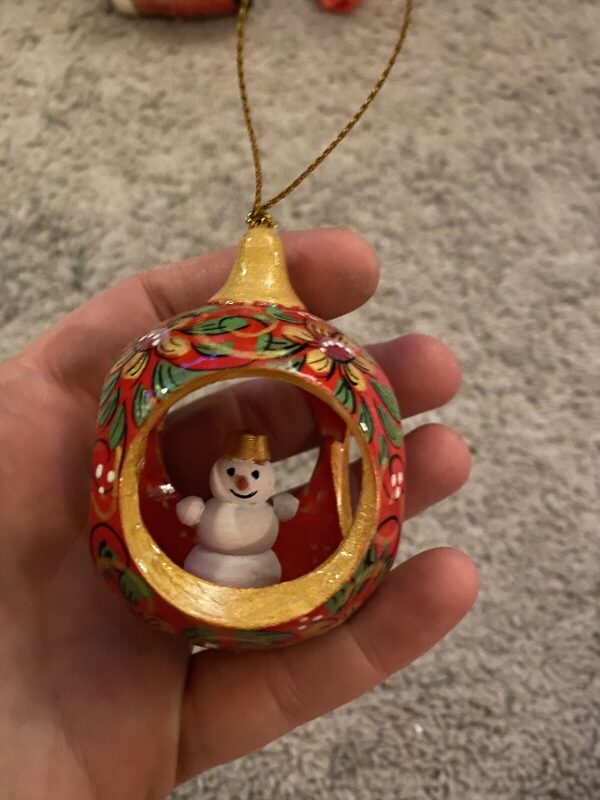
A snowman in a painted window
A turned-wood piece from our shelves in the Russian folk-painted manner: red-and-gold florals outside, walls cut through to a little turned snowman within, the cord threaded straight through its one-piece finial. Proof the lathe can do intimacy as well as engineering.