


Lauscha, where it began
The glass ornament as we know it comes out of Lauscha, a glassmaking village in the Thuringian forest of Germany whose glassworks date back to the late sixteenth century. By the middle of the nineteenth century its glassblowers were producing ornaments in quantity: free-blown balls at first, then mold-blown shapes as the trade grew. Our history chapter follows the whole arc; what matters in this drawer is the material fact that for decades, nearly every glass ornament on an American tree had crossed the Atlantic from a workshop like Lauscha's.
Silvered from within
What makes old glass glow is a silvering solution swirled inside the ornament while it was made, a mirroring technique of the kind associated with the nineteenth-century chemist Justus von Liebig. The silver layer is why a century-old ball can still hold light, and why its loss is so telling: silvering fails from moisture and age in ways that are honest and hard to fake. A piece with worn paint over intact silvering has lived a life; a piece with neither has usually lived a harder one, and should be priced accordingly.
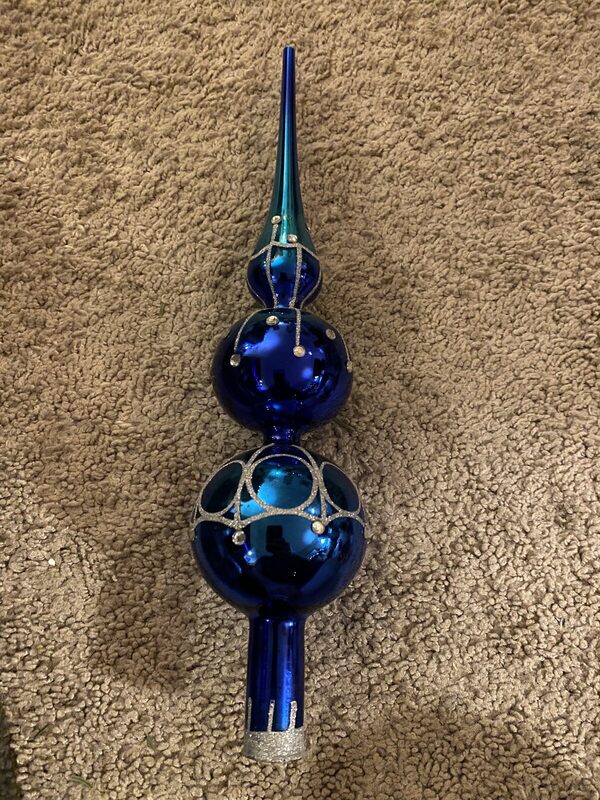
A cobalt spire, silvered within
A blown-glass tree topper from our shelves, cobalt outside and silvered inside, and the silvering is why glass like this holds its light. The glass drawer's tallest resident, and its whole physics lesson in one piece.
The machine-made American century
When war cut off German imports, American production stepped in: by around 1939, the ribbon machines at Corning's Wellsboro plant in Pennsylvania were turning out glass ornament blanks by the millions, and Max Eckardt's Shiny Brite brand put decorated ones in every dime store in the country. Wartime pieces went unsilvered, with paper caps replacing metal, and those austerity ornaments are now among the most collected American glass of all. If a boxed set says Shiny Brite and the box looks like it survived several attics, it probably did, and collectors want it anyway.
Reading a piece of old glass
Before paying real money, read the piece the way the trade does. The neck, under the cap, is where chips hide and where value dies; ask for a photo of it bare. The cap should suit the piece's age and country, and an original cap matters more than sellers admit. The weight talks: old mouth-blown glass runs thin and light, and a suspiciously hefty "antique" ball deserves suspicion. The silvering should fail honestly, in patches and runs, not in uniform artificial dullness. Our Hunting Vintage chapter covers the reproduction tells in full, and the care wing covers what to do once a piece is safely yours.
The rest of the drawer
Two glass families keep their own pages: the heavy early kugels that predate the thin-walled ornament, and the figurals that turned glass into a menagerie. Toppers, the glass drawer's tallest residents, have a buying guide of their own.